
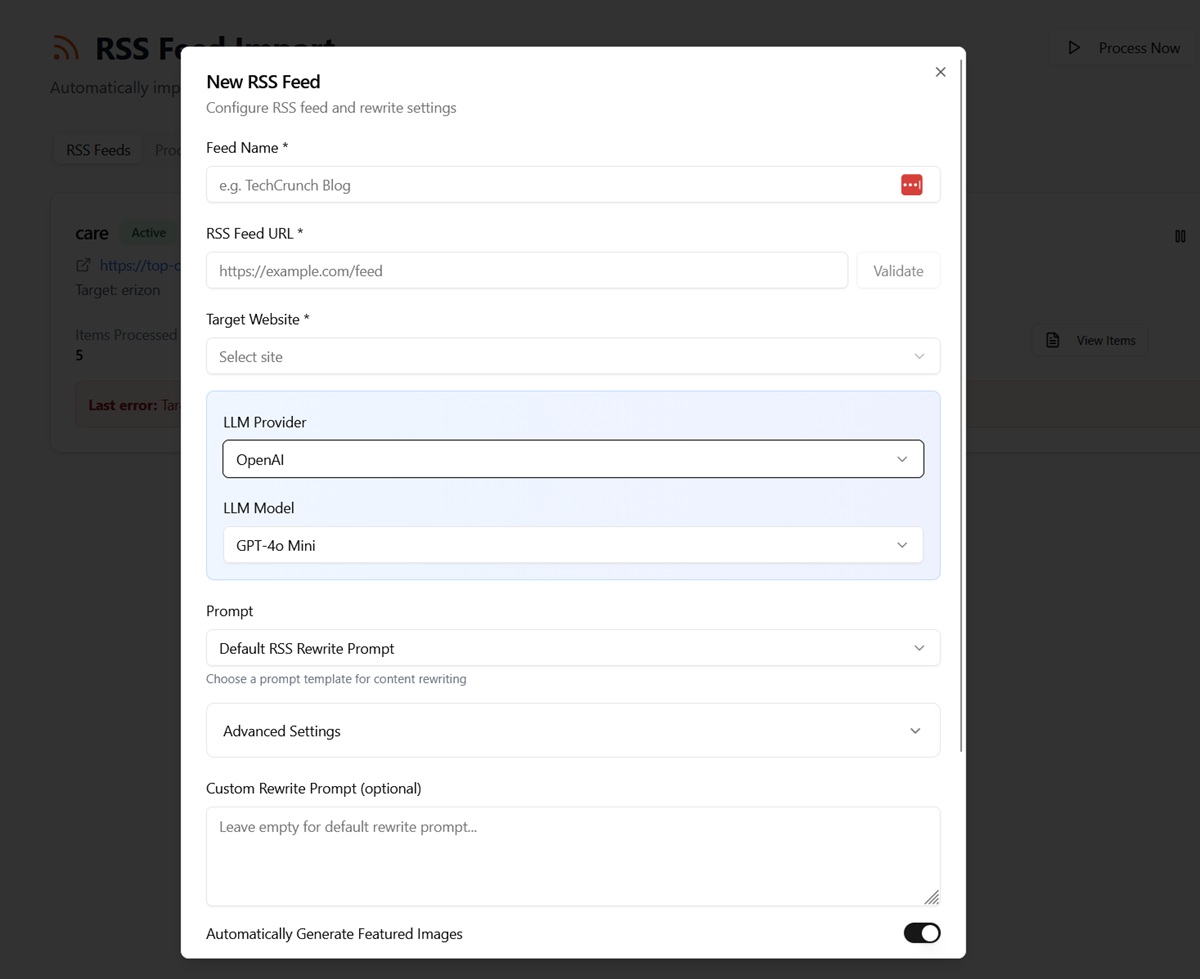
We’ve released a major BETA update to the RSS feature in WP Publisher Pro. While this functionality is still under active development, it already introduces powerful AI-driven automation that turns RSS feeds into scalable, controlled content workflows.
This BETA phase allows us to test, refine, and improve the RSS system together with our users, based on real-world usage and feedback.
From Basic RSS Import to an Intelligent BETA Engine
With this update, we’ve moved beyond traditional RSS importing. Instead of simply pulling in external content, we now process RSS feed items through an AI-powered pipeline that includes rewriting, filtering, scheduling, and publishing.
Because this is a BETA release, our focus is on validating performance, flexibility, and reliability before making the feature generally available.
AI-Powered Content Rewriting (BETA)
We’ve added automated AI rewriting to the RSS workflow. Each RSS item can be rewritten using advanced language models such as GPT-4o and Claude, allowing us to transform external sources into fresh, unique, and SEO-ready articles.
During this BETA phase, we encourage users to experiment with different prompts and rewriting configurations. Output quality may vary depending on source material and settings, and feedback plays a key role in shaping future improvements.
Smart Filtering for Better Control
To keep content relevant, we’ve introduced smart filtering options that allow RSS items to be included or excluded based on keywords. This makes it easier to focus on specific topics and run controlled tests while the feature is in BETA.
These filters help prevent unwanted content from entering your publishing workflow and give you more confidence when testing automation.
Automated Featured Image Generation (BETA)
As part of the RSS BETA, we’ve added automated featured image generation. For each rewritten RSS article, WP Publisher Pro can generate a unique featured image using AI image models such as DALL-E, Stability AI, Fal.ai, and Ideogram.
Because this functionality is still in BETA, we recommend reviewing generated images before fully automating high-volume publishing.
Multi-Site Publishing at Your Own Pace
The RSS BETA supports publishing rewritten content to one or multiple connected WordPress sites. This allows you to test RSS-driven workflows across site networks while maintaining full control over where and how content is published.
You can choose between one-time processing or recurring schedules. During the BETA phase, we recommend starting with smaller batches and scaling up gradually.
Scheduling, Logging, and Transparency
We’ve added full scheduling and logging support to the RSS workflow. Every processed RSS item, published article, or failed job is recorded in the publishing log, giving you clear insight into what the system is doing at all times.
This transparency is essential during BETA testing and helps us identify edge cases and areas for improvement.
Why the RSS Feature Is in BETA
We’ve intentionally marked the RSS feature as BETA because it’s still evolving. While it’s already usable, we’re actively refining AI behavior, performance, and edge-case handling.
Keeping the feature in BETA allows us to:
- Iterate quickly
- Improve rewriting quality and filtering logic
- Optimize stability and performance
- Incorporate real user feedback before final release
Who the RSS BETA Is For
The RSS BETA is ideal for:
- SEO agencies testing automated content pipelines
- Publishers experimenting with curated content workflows
- Advanced users who want early access to new automation features
It may not yet be suitable for fully hands-off, high-risk production environments without review.
What’s Next
The RSS feature will remain in BETA while we continue to add refinements, controls, and performance improvements. Feedback during this phase directly influences the final version.
With this update, we’re laying the foundation for turning RSS into a reliable AI-powered content engine—while keeping expectations clear during the BETA phase.